

Nvidia’s Huang Takes a Different Line on AI Risk At Dreamforce Conference
AI Leaders Diverge Over Speed and Safety
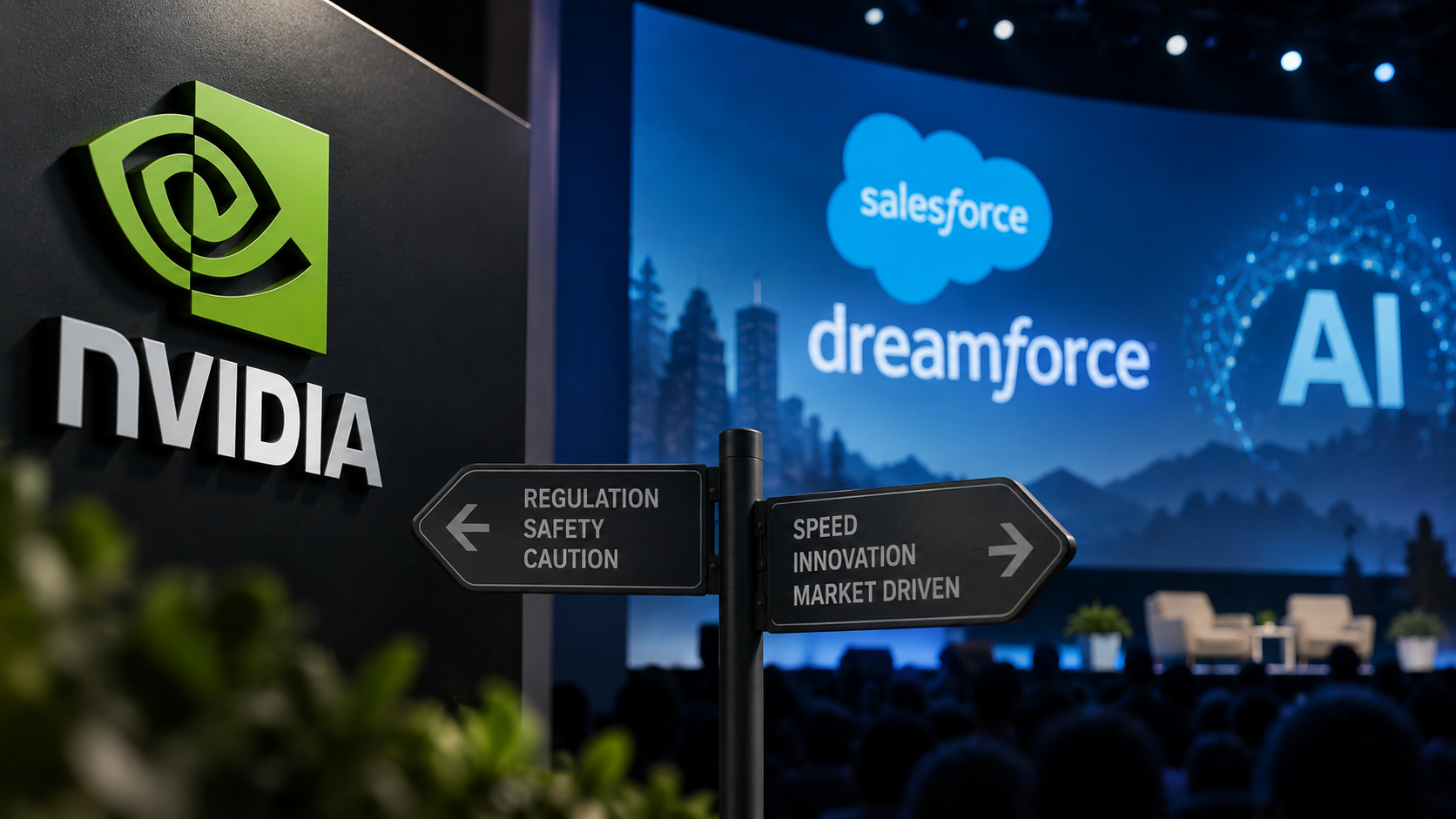
AI Leaders Diverge Over Speed and Safety
Key Takeaway:
Amodei and Altman called for stronger AI safeguards, stressing that safety and monitoring should keep pace with — and, where possible, come before — advances in model capabilities.
Huang took a different view, arguing that companies can move quickly without compromising safety, provided they are willing to pause when a product is not ready for release.
The executives also disagreed over regulation. Amodei supported a more cautious, slower approach to AI development, while Huang placed greater emphasis on market forces and companies’ responsibility to manage risks themselves.
At Salesforce’s (CRM) Dreamforce conference, Anthropic CEO Dario Amodei and OpenAI CEO Sam Altman urged the AI industry to take a more cautious approach to developing increasingly powerful systems. Their views differed from those of Nvidia CEO Jensen Huang, who argued that companies can move quickly while still maintaining appropriate safety measures.
The discussion comes as concerns about AI risks gain wider attention. Researchers and industry leaders have warned that increasingly capable models could pose serious social and security threats if safety testing, monitoring and oversight fail to keep pace with development.
Amodei appeared alongside Salesforce CEO Marc Benioff during the company’s keynote in San Francisco, shortly after publishing an essay calling for a slower pace of AI development. He said companies should acknowledge that their safety practices can always be improved and argued that a more deliberate approach would not necessarily undermine innovation, commercial growth or U.S. leadership in the field.
He has proposed a three-part plan to moderate the rapid increase in AI capabilities while allowing the industry to remain competitive. His position has received support from Altman, Elon Musk and Google DeepMind Chair Demis Hassabis, particularly amid warnings that poorly controlled AI systems could cause catastrophic harm.
Huang offered a contrasting view when he later joined Benioff onstage. He argued that market pressures already encourage companies to act responsibly and questioned whether additional regulation is necessary to manage every AI-related risk.
The debate took place alongside announcements highlighting the close business ties among the companies involved. Salesforce and Nvidia unveiled a new reasoning model for the Agentforce platform based on Nvidia’s open-weight Nemotron technology. Salesforce and Anthropic have also introduced Claudeforce, which connects Anthropic’s Claude chatbot with sales data.
During a later fireside chat with Benioff, Altman said safety and monitoring should take priority over improving model capabilities. He argued that companies must act responsibly regardless of what their competitors are doing, rather than treating safety as conditional on the behavior of others.
The Nvidia CEO also described the conflict between speed and safety as a false choice. In his view, companies should move as quickly as they can while remaining prepared to pause if a product proves unsafe or cannot be adequately controlled.
Ali Merchant is a seasoned financial markets professional specializing in technical analysis, treasury & capital markets, trading, research, and fund management. He is Strategic Advisor at Musaffa and Founder of TWT Learning, which provides education, research, and advisory services to fund and hedge managers and family offices. Ali has traded FX, FX options, US stocks & options, indices, commodities, oil and metals futures, and holds a CMT charter with memberships in AAPTA and CMT, US & Canada. He has worked with ABN AMRO, Thomson Reuters/Refinitiv, MAK Allen & Day Capital, and Bridge Information Systems, produced TA reports for Bloomberg and Reuters, and trained 2,000+ market participants across North America, the GCC and Asia.