

NVIDIA (NVDA) Q2 2027 Earnings Review
NVIDIA Corp (NVDA Aug 28, 2026, close, $217.55)
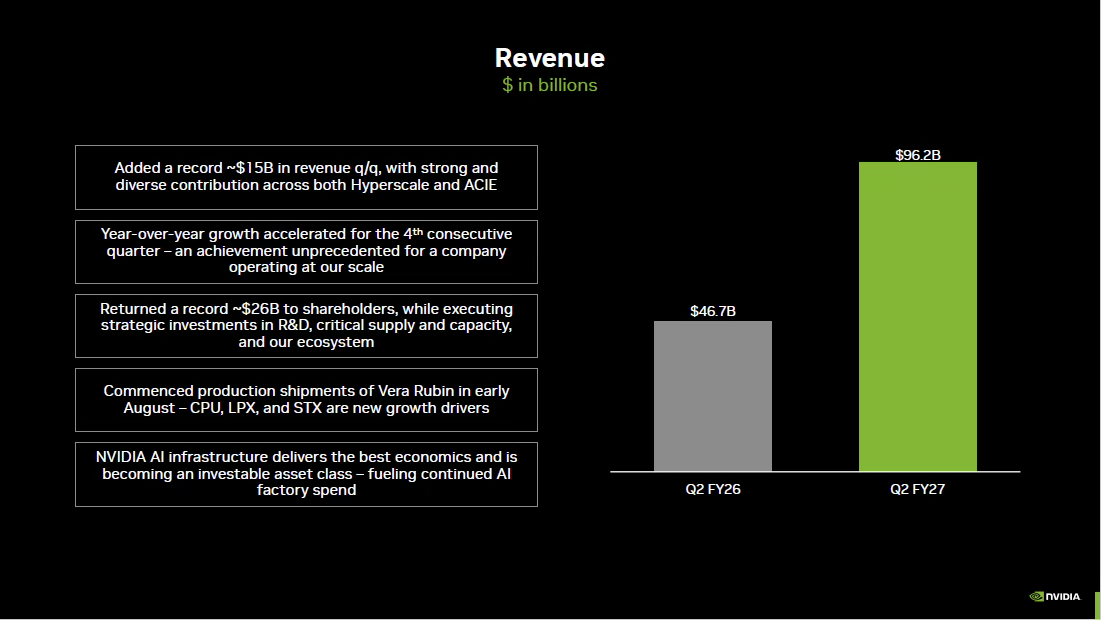
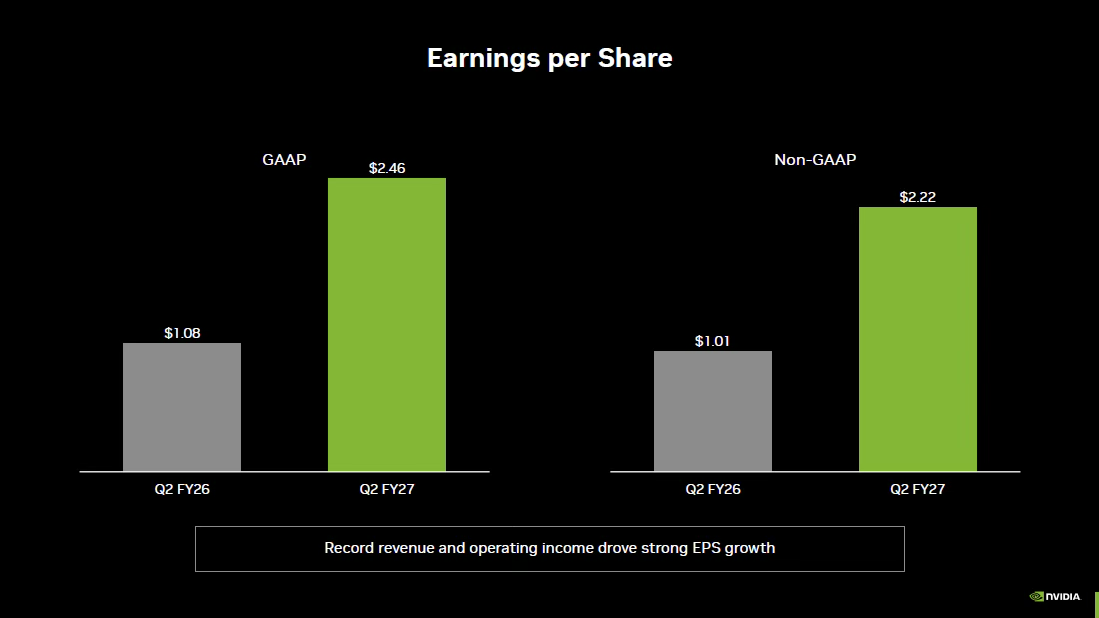
Nvidia crushed expectations in Q2 FY2027, reporting $96.2 billion in revenue, $4.3 billion above estimates and adjusted earnings of $2.22 per share, a 6.7% upside surprise. The results marked the company’s 15th consecutive quarter of beating analyst forecasts.
The bigger shock came from Nvidia’s FY2028 outlook, which projects roughly 70% growth, nearly double Wall Street’s 45% expectation. Investors responded enthusiastically, sending Nvidia shares up 9.7% to $229.96.
Nvidia reported second-quarter earnings results after Wednesday's market close.
Here's what to know
Adjusted earnings per share: $2.22, higher than $1.05 a year ago
Sales: $96.2 billion, higher than $46.7 billion a year ago
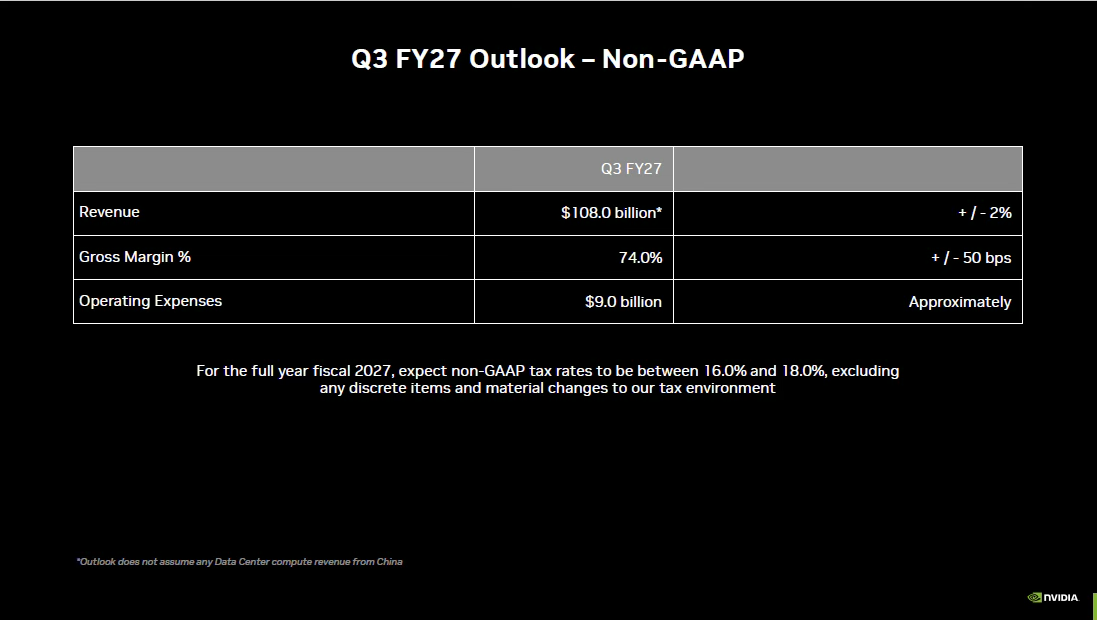
Outlook: FYQ3 sales of $108 billion, "plus or minus 2%"
Source: NVDA Investor presentation Q2 FY27
Nvidia’s Data Center Business Powers Fresh Growth Surge
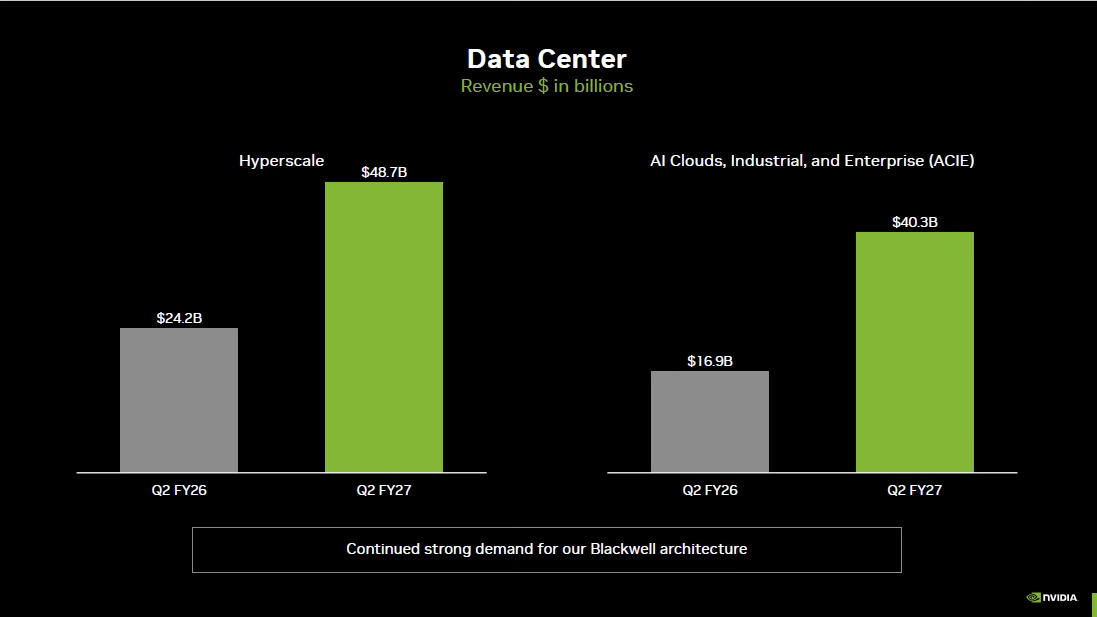
Data center revenue: $89 billion, up from $41 billion year over year
Share of total sales: Data center operations generated 93% of Nvidia’s revenue
Hyperscaler growth: Sales increased 102%
Other customer growth: Revenue rose 138%
Customer diversification: Results suggest Nvidia may be less dependent on hyperscalers than previously believed
Edge segment revenue: $7.2 billion
Analysts’ estimate: $6.6 billion
Edge segment performance: Beat expectations, driven largely by gaming and automotive chip sales
Nvidia Keeps Profitability Strong Amid Rapid Expansion
Q2 gross margin: 75%, in line with Wall Street expectations.
Strong profitability: Nvidia remained highly profitable despite slightly cautious guidance.
Operating margin: 66.5%, exceeding analysts’ forecasts.
Year-over-year improvement: Operating margin increased from 64.5% last year.
Operating leverage: The improvement indicates Nvidia is generating more profit from each dollar of revenue.
Q3 outlook: Gross-margin guidance came in slightly below Wall Street’s projections.
CFO Forecast
Nvidia shares rose after CFO Colette Kress forecast approximately 70% revenue growth for fiscal 2028.
Accelerating-growth expectations helped ease market concerns about the sustainability of the artificial-intelligence investment boom and fears of excessive spending.
Nvidia defended its strategy of supporting customers financially, with Kress predicting that major frontier AI companies such as OpenAI could become some of the largest technology companies ever.
Investor concerns are shifting: Rather than questioning demand for Nvidia’s chips, the market is increasingly focused on whether the broader AI investment cycle will generate sufficient returns.
Earnings beats matter less than before because Nvidia’s shares are no longer viewed as being “priced to perfection,” making the company’s market reaction a broader gauge of confidence in the AI narrative.
Nvidia shares rose after CFO Colette Kress forecast approximately 70% revenue growth for fiscal 2028.
Accelerating-growth expectations helped ease market concerns about the sustainability of the artificial-intelligence investment boom and fears of excessive spending.
Nvidia defended its strategy of supporting customers financially, with Kress predicting that major frontier AI companies such as OpenAI could become some of the largest technology companies ever.
Investor concerns are shifting: Rather than questioning demand for Nvidia’s chips, the market is increasingly focused on whether the broader AI investment cycle will generate sufficient returns.
Earnings beats matter less than before because Nvidia’s shares are no longer viewed as being “priced to perfection,” making the company’s market reaction a broader gauge of confidence in the AI narrative.
Bigger Financial Risks to Sustain AI Data-Center Boom
Nvidia’s future financial commitments are expanding rapidly, mirroring a broader trend among major technology companies.
New second-quarter supply agreements, particularly for high-cost memory, drove total supply commitments to $279 billion, up from $119 billion three months earlier.
Nvidia has an additional $143 billion in commitments tied to cloud-service contracts, leases, equity investments, and capital expenditures.
The company has guaranteed $109 billion in customer debt, increasing its potential financial exposure.
The scale of these obligations reflects Nvidia’s aggressive investment in AI infrastructure but also introduces greater long-term financial risk.
Nvidia Pledges to Return More Cash to Shareholders
Nvidia returned $26 billion to shareholders through dividends and share repurchases in the second quarter.
Total shareholder returns for the first half reached 60% of free cash flow, exceeding the company’s 50% target.
The company plans to increase the amount of excess free cash flow returned to investors.
Nvidia will prioritize strategic investments before distributing remaining excess cash.
CFO Colette Kress said the company intends to return more excess free cash flow going forward.
Analysts Expectation – Post NVIDIA Q2 Earnings
Freedom Broker increased its price target for NVIDIA from $275 to $305 while maintaining a Buy rating.
Truist Securities raised its NVIDIA price target to $346 from $307, maintaining a Buy rating. The firm cited stronger-than-expected demand visibility for NVIDIA’s products.
TD Cowen reiterated its Buy rating on (NVDA) and maintained a $275 price target.
SHARIAH Compliance Metrics of Nvidia (NVDA)
NVDA is “HALAL” based on AAOIFI methodology as of Q1 2027 report.
Business Activity 98.71% Halal, Doubtful is 0.74%, and non-Halal is 0.55%.
Interest-bearing securities and assets = 1.53% (Shariah-complaint is < 30%).
Interest-bearing debt = 0.26% (Shariah-complaint is < 30%).
You can get a more detailed breakdown of NVIDIA's Shariah status on its stock page.