

It is a crucial week for U.S. market players amid Nvidia quarterly results, big-box retailers’ performance, and an increasing likelihood of rate hikes from the Fed. Market watchers are weighing the overall strength of stocks against high volatility in the AI segment as a result of dramatic management turnover at Nvidia along with ongoing wholesale price pressures.
Traders have become convinced about the inevitable interest rate hike in December by pricing such outcomes already into their calculations, which leaves retail sales figures in the United States, minutes of the Fed’s meeting held last week, and corporate statements regarding the consumer demand during the holiday period as the key focal points.
Last Week Market Recap
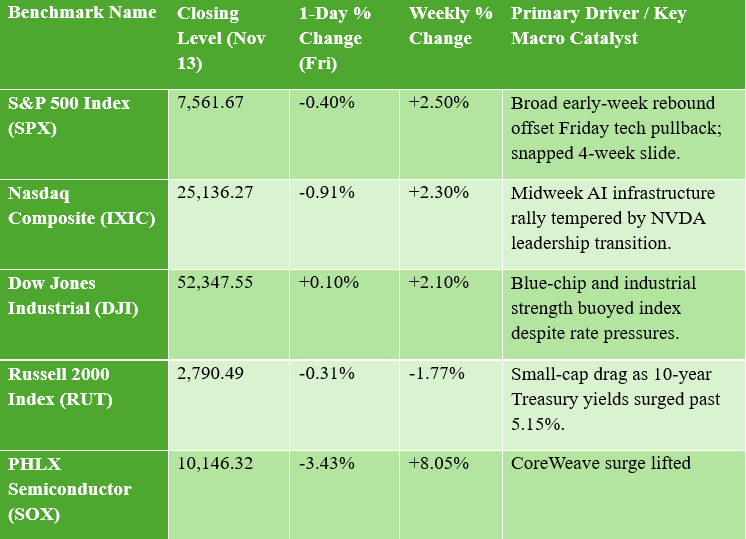
US stocks ended their four consecutive weekly decline as markets witnessed a week full of volatility but ending on a negative note as semiconductor stocks were under selling pressure late in the week. The S&P 500 index was up 2.5% and closed the week at 7,561.67. The Nasdaq Composite gained 2.3% and closed at 25,136.27. Meanwhile, the Dow Jones Industrial Average closed the week at 52,347.55 and gained 2.1%.
The S&P 500 index saw all 11 sectors gain and Energy Sector (5.53%) and Industrials Sector (3.79%) outperformed all others. Meanwhile, the Philadelphia Stock Exchange Semiconductor Index (SOX) gained +8.05% to 10,146.32 but fell sharply -3.43% on Friday after resignation of Nvidia’s CEO Jensen Huang. The rate sensitive Real Estate Sector (0.70%) and Basic Materials Sector (0.49%) had lowest gains amid higher yields of 10-year Treasury notes above 5.1%.
Major Market Benchmarks Performance (Prior 5 Trading Days)
Fixed Income, Commodities & Currency Baseline
10-Year Treasury Yield (US10Y): Increased consistently to reach 5.14% - 5.15% (with a high point at 5.174%) on the back of strong wholesale inflation figures.
2-Year Treasury Yield (US2Y): Surged by around 30 bps to reach 4.56% - 4.86% in anticipation of an interest rate hike.
US Dollar Index (DXY): Rose consistently in all five trading sessions to climb from 101.65 to 20-month high of 103.41 on the back of hawkish Fed pricing.
West Texas Intermediate Crude Oil: Plunged to $88.56/bbl due to falling chances of military confrontation between the U.S. and Iran.
Brent Crude Oil: Declined to $95.84/bbl as the second consecutive weekly decline in crude oil price.
Gold Spot (XAU/USD): Slashed over 4% from $4,120/oz to $3,880/oz on the back of rising yields and strong dollar.
This Week’s Key Earnings and Economic Events
The company earnings calendar is centered around AI hardware leadership and bellwethers of American retail. TSN, BIDU, and XPEV are scheduled for Monday morning before the bell. The week kicks off with HD before the bell on Tuesday, followed by a market highlight post-market: NVDA and DIS. Big box retail companies Target (TGT), Lowe’s (LOW), and TJX Companies (TJX) release earnings before the bell on Wednesday, while Palo Alto Networks (PANW) reports after the bell the same day. WMT and BABA are scheduled for Thursday before the bell, followed by INTU and ROST after the bell.
In terms of economics, there are no important monthly inflation and jobs releases, which makes consumer spending and central bank communications key drivers. On Monday, NY Empire State Manufacturing Index and the speech by Fed Chair Kevin Warsh are expected. On Tuesday, October U.S. Retail Sales and Industrial Production are due. On Wednesday, October Housing Starts and FOMC meeting minutes for October 27-28 are set for release, while on Thursday Weekly Initial Jobless Claims data will be available and on Friday November University of Michigan Consumer Sentiment.
Key Market Catalysts to Watch This Week
Nvidia Faces Leadership and AI Demand Test
Following the unexpected resignation of CEO Jensen Huang and the elevation of CFO Colette Kress to the role of interim CEO on November 12, Nvidia’s Tuesday after-the-bell results become the true litmus test for the AI infrastructure industry.
Nvidia (NVDA): Wall Street expects EPS of $2.47–$2.49 for Q3 FY27 based on revenue between $108.8B and $109.4B (~91% YoY growth versus $57.0B last year), beating management’s $108B midpoint estimate. The spotlight will be on Blackwell ramping, early Vera Rubin installations, gross margin, and whether management sticks to its target of 70% revenue growth for FY28.
Alibaba (BABA): Results expected Thursday morning, with consensus calling for EPS of $1.65 on $40.43B revenue. The question will be how to balance out fast-growing AI cloud investments (+45% YoY in the previous quarter) while dealing with margin pressure because of large-scale infrastructure investment.
Retail Bellwethers Gauge Holiday Consumer Resilience
Amidst positive S&P 500 Q3 blended earnings growth of +31.9% YoY along with revenues growing by +14.4% YoY (according to FactSet), major retail companies will shed light on the sustainability of consumer spending going into the holidays.
Walmart (WMT): Announces Thursday after the bell with estimated EPS of $0.64 (+3.2% YoY) on $186.5B-$187.3B (+3.9% YoY) revenues.
Target (TGT) & Lowe's (LOW): Both announce Wednesday after the bell. Target's expected EPS is $2.06-$2.07 with an estimated revenue of about $26.51B while Lowe's' is expected to earn EPS of $2.86 (-6.5% YoY) on $22.38B (+7.5% YoY) revenues.
Hawkish Fed Trajectory and Retail Sales Data
Following the October acceleration in annual PPI inflation to 6.5% (the highest 12-month increase since November 2022), fixed income markets swiftly priced a repricing of the Fed rate path.
In this respect, the implied probability for a 25-basis points rate hike by CME FedWatch futures in the December 8-9 meeting ranges from 91.3% to 93.0%, whereas there is a secondary market probability of around 67% for a second consecutive hike in January 2027.
The release of October 27-28 FOMC meeting minutes (with its close 10-to-2 vote to keep rates unchanged at 3.75%-4.00%) together with October Retail Sales data (expected: +0.5% MoM; previous: +0.8% MoM) on Tuesday will put to test consumer resilience to sustained policy normalization.