

U.S. investors begin a shortened Thanksgiving week with an equities market that is weighed down by front-loaded institutional risk of big-tech artificial intelligence (AI) server earnings results from Hewlett Packard Enterprise and Dell Technologies coupled with a jam-packed, five-report macroeconomic data cluster set for Wednesday morning. Equities are straining to recover from a brutal five-day descent that found the S&P 500 and Dow Jones Industrial Average in correction.
As the Federal Reserve’s FOMC blackout period approaches on Saturday, Nov. 28, the recent October Personal Consumption Expenditures (PCE) inflation number and a Q3 GDP revision that comes out on Wednesday will be key drivers in front of next month’s policy gathering. The tone of how enterprise hardware companies manage the competing influences of rising AI server sales and component margin squeeze and whether inflation data supports hawkish Fed pricing will determine market course.
Last Week Market Recap
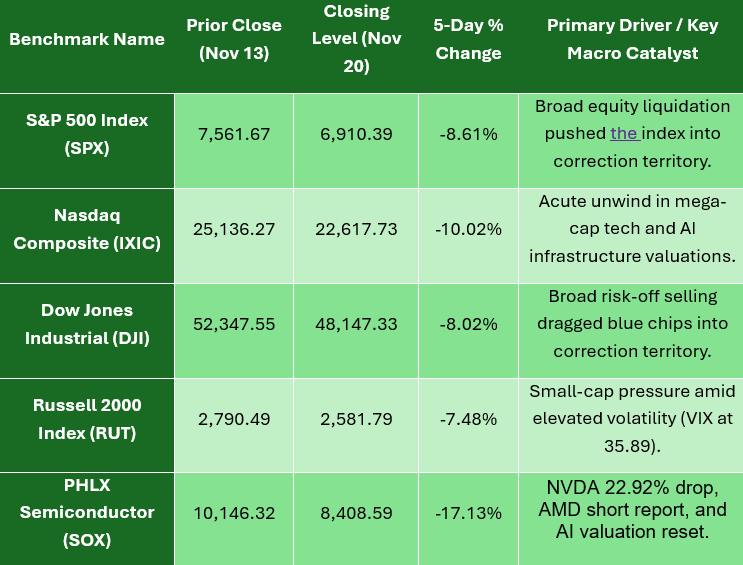
The US equity market saw widespread selling pressure last week, driven by a severe correction in AI and semiconductors stocks that prompted investors to flock to US Treasuries and the USD. The S&P 500 index declined by 8.61% to 6,910.39, with the technology index NASDAQ Composite being the worst performer, losing by 10.02% to end at 22,617.73. Dow Jones Industrial Average declined by 8.02% to 48,147.33, whereas the small-cap Russell 2000 index slipped by 7.48% to 2,581.79.
Semiconductors took the hardest hit, with PHLX Semiconductor Index (SOX) falling 17.13% to 8,408.59 on executive churn and a 22.92% weekly decline on Nvidia, a bearish short-seller report on AMD, and profit taking in the context of Anthropic’s market debut. All 11 GICS sectors declined on the week, with Information Technology (-12.49%) and Communication Services (-9.60%) providing some relative strength while the defensive-oriented Consumer Staples (-1.80% to -1.99%) and Utilities (-3.20% to -3.29%) declined less than others.
Major Market Benchmarks Performance (Prior 5 Trading Days)
Fixed Income, Commodities & Currency Baseline
10-year Treasury Yield (US10Y): Fell 23bps to 4.92%, losing the 5.00% level amid duration safe-haven flows.
2-Year Treasury Yield (US2Y): Declined 25 bps to 4.63%. The 2s/10s yield curve spread remained at +29 bps.
U. S. Dollar Index (DXY): Up +0.39% to 103.81, after having begun a multi-week advance on haven buying and December rate-hike pricing.
WTI Crude Oil: Oil retreated -4.44% to $83.41/bbl as an uptick in US inventories and warnings of global oversupply cut through safe-haven demand from Middle East shipping risks.
Brent Crude Oil: Settled -6.15% at $89.95/bbl.
Gold Spot (XAU/USD): Down -9.12% to $3,524.80/oz as the dollar grew stronger, with solid real yields and a liquidation of cross-asset margins.
This Week’s Key Earnings and Economic Events
Corporate reporting is dominated by Thursday Thanksgiving market holiday close. On Monday, Hewlett Packard Enterprise (HPE), Agilent Technologies (A), Jacobs (J), and Zoom Communications (ZM) on the close. Tuesday accounts for about two-thirds ($786B of $1.17T) of the reporting market cap for the week, opening with Analog Devices (ADI), Medtronic (MDT), Best Buy (BBY), and Dollar Tree (DLTR) before the open, then at the close is Dell Technologies (DELL), Workday (WDAY), Autodesk (ADSK), and HP (HPQ). Deere & Company (DE) reports on Wednesday morning.
Economics on the economic calendar Wednesday’s schedule in the US include the release of five key reports ahead of the holiday: Q3 2026 GDP (Second Estimate), October PCE, October PCE Core Inflation, October Durable Goods, and Weekly Initial Jobless Claims are all due at 8:30 a.m. ET, while October New Home Sales is announced at 10:00 a.m. ET and the Federal Reserve Beige Book comes out at 2:00 p.m. ET. The US markets are closed on Thursday for the Thanksgiving holiday while the US stock and bond markets are closed for trading on Thursday and closed for an early close Friday (1:00 p.m. ET for stocks; 2:00 p.m. ET for bonds).
Key Market Catalysts to Watch This Week
AI Server Leaders Face Margin and Backlog Scrutiny
While S&P 500 Q3 2026 blended earnings growth is tracking at +32.9% YoY on +14.6% revenue growth (per FactSet, 93% of constituents reported), enterprise hardware leaders need to demonstrate that these enormous hyperscaler CapEx commitments can lead to durable margins.
Dell Technologies (DELL): Earnings Tuesday after the close with consensus at Q3 FY27 EPS of $6.48–$6.63 (+155.6% to +175.7% YoY) on sales of $49.32B (+82.6% YoY). Options prices suggest about a ±16.1% swing as attention is focused on the $19.00B of Q3 FY27 AI server backlog conversion (guidance), the $74.00B FY27 AI-optimized server sales forecast, and if increasing memory costs are weighing on ISG margins.
Hewlett Packard Enterprise (HPE): Earnings Monday AMC, consensus Q4 FY26 EPS of $1.28–$1.29 on $14.43B–$14.47B in revenue (+49.1% to +49.5% YoY). Watch points for HPE include the Cloud & AI segment (+60% to +72% YoY), Juniper-boosted Networking margins, and share repurchases.
Black Friday Consumer Monetization: Real-time estimates Tuesday morning from Best Buy (BBY; consensus EPS $1.48–$1.49 on revenue of $9.89B) and Dollar Tree (DLTR; EPS of $0.89–$0.91 on $5.04B revenue) will provide early Black Friday consumer elasticity and tariff-related return on margin updates.
Pre-Holiday Inflation Cluster Shapes December Fed Path
Wednesday’s 8:30 AM ET macro cluster offers a lot of pre-market gap risk in a market that is leaving the week at the VIX 35.89 heading into the FOMC blackout period beginning November 28.
Per CME FedWatch, Fed Funds futures are pricing in an 86.4% chance of a 25 bps rate hike to 4.00-4.25% at the Dec. 8-9 FOMC meeting, with a 75.4% probability of a subsequent hike in January 2027. After hawkish Oct FOMC minutes that reiterated risks to sticky inflation from an AI-powered supply chain and faster interest rate hikes, consensus sees Oct Core PCE inflation print rising from 3.1% to 3.2% YoY. Outperformance in PCE inflation or Q3 GDP (initial estimate: +3.4% annualized) will be the real bullish flag for the "higher-for-longer" tightening paradigm.