
AI Boom Sends AMD Past the $1 Trillion Market Cap Mark
AMD Becomes Fourth U.S. Chipmaker Worth $1 Trillion
AMD Becomes Fourth U.S. Chipmaker Worth $1 Trillion
Key Takeaway:
AMD crossed the $1 trillion market-capitalization milestone, becoming the fourth U.S. chipmaker to do so.
Its stock jumped 9.6% to a record $613.31, nearly tripling since the start of the year.
Investors are increasingly viewing AMD as a major force in AI computing and Nvidia’s closest GPU competitor.
The rally spread across the sector, with Intel up 11.8%, Qualcomm up 4.5%, and the Philadelphia Semiconductor Index gaining 2.7%.
Renewed confidence in AI helped offset concerns about hyperscaler spending, high oil prices, and interest rates, as investors sought growth opportunities during a possible slowdown.
Advanced Micro Devices (AMD) surpassed a $1 trillion market valuation for the first time on Monday, joining an exclusive group of U.S. chipmakers to reach the milestone. AMD shares climbed 9.6% to a record $613.31, bringing the total gains for the year to nearly threefold as investors increased their confidence in the company’s growing role in artificial-intelligence computing.
Is AMD Halal? Check Shariah Status -->
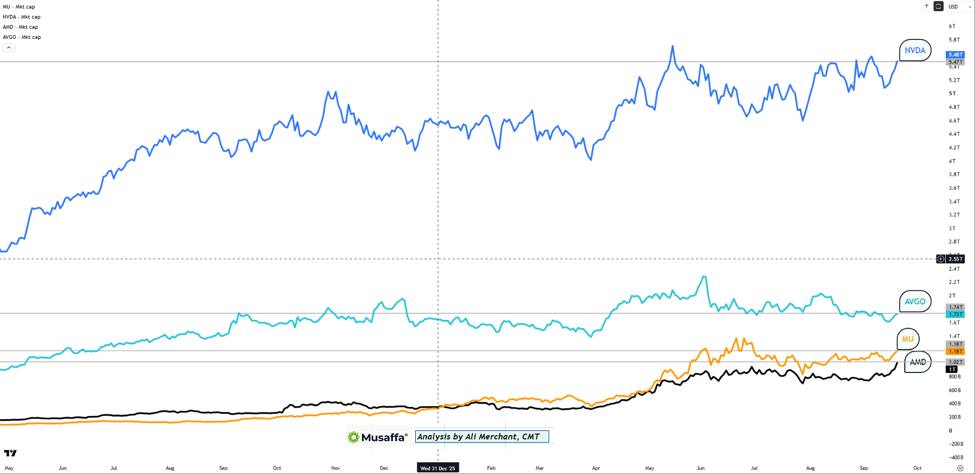
AMD is now the fourth U.S. chipmaker to exceed a $1 trillion valuation, following Nvidia, Broadcom, and Micron. Nvidia reached the milestone in 2023 and has since become the world’s most valuable company, with a market value of more than $5 trillion. AMD is Nvidia’s closest competitor in the graphics-processing-unit market.
The broader semiconductor sector also rallied, despite recent concerns over hyperscaler AI spending, higher oil prices linked to the U.S.-Iran conflict, and expectations that interest rates could remain elevated. Intel shares jumped about 11.8%, Qualcomm gained 4.5%, and the Philadelphia Semiconductor Index rose 2.7% to its highest level in more than a month.
Beyond Semiconductors
AMD is broadening its AI strategy beyond selling standalone chips. It is now offering integrated systems that combine CPUs, GPUs, networking equipment, and related hardware, putting it in more direct competition with Nvidia. Demand for CPUs used alongside GPUs in AI-inference servers is also helping AMD take market share from Intel.
The company’s latest revenue guidance exceeded Wall Street’s formal estimates but fell short of the much higher expectations investors had built into the stock. Despite that disappointment, AMD shares have risen 185% in 2026, substantially outperforming the Nasdaq’s 15.8% gain.
At around 41 times projected earnings over the next 12 months, AMD trades below its 10-year average valuation of 44 times earnings. However, it remains considerably more expensive than Nvidia, whose forward price-to-earnings ratio was recently about 16.3. This suggests investors are assigning AMD a substantial premium for its expected AI growth, while also pricing in significant execution risk.
Also Read:

Ali Merchant is a seasoned financial markets professional specializing in technical analysis, treasury & capital markets, trading, research, and fund management. He is Strategic Advisor at Musaffa and Founder of TWT Learning, which provides education, research, and advisory services to fund and hedge managers and family offices. Ali has traded FX, FX options, US stocks & options, indices, commodities, oil and metals futures, and holds a CMT charter with memberships in AAPTA and CMT, US & Canada. He has worked with ABN AMRO, Thomson Reuters/Refinitiv, MAK Allen & Day Capital, and Bridge Information Systems, produced TA reports for Bloomberg and Reuters, and trained 2,000+ market participants across North America, the GCC and Asia.