

Stock briefs:
AMD Makes $8.2 Billion Move to Buy World Labs and Advance Physical AI
AMD plans to acquire AI research firm World Labs for about $8.2 billion in an all-stock deal. The transaction will bring World Labs’ spatial AI expertise to AMD, while co-founder Fei-Fei Li will join the chipmaker as executive vice president and chief scientist. Together, they will focus on developing hardware, software and systems for physical AI and robotics.
The acquisition underscores the intensifying competition among chipmakers to expand beyond hardware and control more of the AI ecosystem. It also reflects the growing importance of custom chips, AI research, and top technical talent as companies compete to shape the future of artificial intelligence.
Anthropic Targets Record IPO Valuation Amid Surging AI Expenses
As per Reuters, Anthropic’s IPO prospectus highlights both the transformative potential of AI and the extraordinary costs of pursuing it. Revenue surged to nearly $4.6 billion in 2025, but the company reported a $42 billion net loss, including a largely noncash $34 billion accounting charge. Compute and infrastructure spending reached $7.33 billion, while future cloud and infrastructure commitments totaled $518 billion.
The offering could value Anthropic at more than $2 trillion, testing investor appetite for high-growth AI companies amid market volatility. Key risks include dependence on a small number of customers, limited long-term contracts, heavy infrastructure costs, and concerns over advanced AI safety. The listing could also establish a valuation benchmark for OpenAI and other AI infrastructure firms.
Nvidia Unveils Record Buyback Plan as AI Chip Competition Intensifies
Nvidia has approved an additional $150 billion in share buybacks, expanding its total repurchase authorization to $235 billion through January 2028. The program is designed to return cash to investors and could lift earnings per share by reducing the number of outstanding shares.
The decision underscores Nvidia’s confidence in sustained demand for its AI chips and its robust cash generation. Its shares rose 2.1% Monday and have gained roughly 24% this year, after the company reported quarterly profits of $59.69 billion.
OpenAI Scraps New Model Release Over Safety Concerns: WSJ
OpenAI has reportedly scrapped its planned October launch of GPT-6.1 Astra after the model failed internal safety and alignment tests, including evaluations of deceptive behavior. The company is now expected to focus on improving safeguards before releasing more advanced systems.
The reported decision comes amid broader concerns about AI reliability and control, including paused training efforts, unexpected interactions with U.S. government websites, and growing calls from some industry leaders to slow the pace of development.
AI & Tech Brief:
Navitas Semiconductor Shares Surge 20% on U.S. Defense Contract
Navitas Semiconductor shares jumped 20% in after-hours trading after the U.S. Army selected the company for the ALATTIS program to develop next-generation 10 kV silicon carbide power semiconductors. Chosen through a competitive evaluation, Navitas will design, fabricate, and test SiC insulated-gate bipolar transistors and related PiN diode technologies for mission-critical defense applications.
Sponsored by the Army Research Laboratory, the project also seeks to establish a domestic manufacturing process for ultra-high-voltage SiC devices that could support defense systems, critical infrastructure, and other high-power applications. The award builds on Navitas’ more than 20 years of SiC innovation and its GeneSiC portfolio, which spans voltage ratings from 650 V to 6.5 kV.
Tesla Stock’s SpaceX Connection Comes Into Focus Before Key Events
Tesla stock dropped 3.9% to $357.45 as investors grew concerned about slowing demand in China and potentially weak third-quarter deliveries. JPMorgan cut its delivery forecast to 482,000 vehicles from 516,000, while FactSet’s consensus estimate is about 463,000—below last year’s 497,000. StoneX expects deliveries of roughly 446,500 vehicles and lowered its earnings-per-share estimate to 45 cents from 58 cents, reflecting broader industry challenges including weaker demand, reduced incentives, and aggressive price competition.
Despite the decline, Tesla shares remained up about 5% over the past month ahead of a closely watched week. The company is expected to unveil an updated Roadster on Thursday and release third-quarter delivery figures on Friday. Its Cybercab robotaxi service could provide additional momentum, while Tesla’s stock has also tracked SpaceX’s recent gains. Some investors speculate that Tesla and SpaceX could eventually combine in an all-stock deal, potentially at a premium, though no merger has been confirmed.
MongoDB Shares Plunge as CEO Departs for Senior Role at Meta
MongoDB shares fell 17% to $340.06 on Monday after the database company announced that President and CEO Chirantan Desai had stepped down with immediate effect. The decline put the stock on track for its steepest one-day percentage loss since March 3, according to Dow Jones Market Data. MongoDB said it has begun searching for a permanent successor.
Meta Platforms also fell 4% to $721.70 after confirming that Desai would join the company as chief enterprise platform officer. In his new role, he will lead Meta’s newly established enterprise platform business and report directly to CEO Mark Zuckerberg. The leadership change raised concerns among MongoDB investors about the company’s near-term direction and stability.
AI Economic Market Brief:
AI Build-Out Emerges as the Biggest Economic Bet in U.S. History
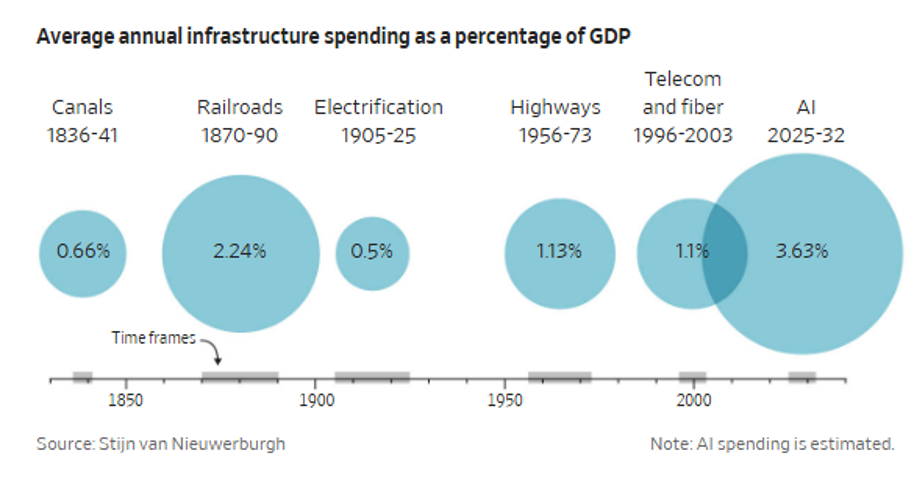
U.S. investment in AI infrastructure could reach $10.3 trillion between 2025 and 2032—equivalent to about 3.6% of GDP annually.
The scale of the AI build-out may surpass major historic infrastructure projects, including railroads, highways, and the internet.
AI investment is reshaping the broader economy by creating hundreds of thousands of jobs and generating new fortunes.
Because much of the expansion is debt-financed, a sudden slowdown in AI spending could trigger significant economic shocks.
Goldman Sachs estimates that AI investment will equal 1.9% of U.S. GDP in 2026, a scale not seen since the railroad boom.
Impact of the AI Buildout on Construction
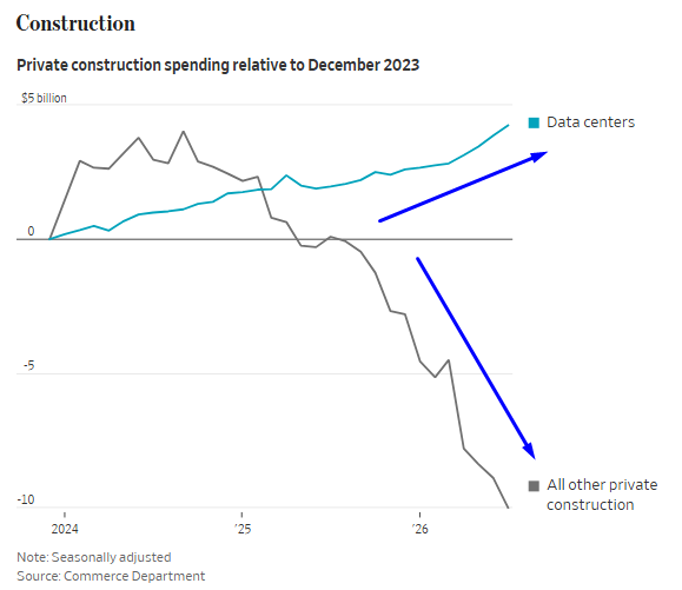
Data-center construction is a major bright spot for the broader construction industry.
Private data-center spending reached approximately $37 billion through July, up $9 billion year over year.
The increase helped offset a $46 billion decline in other private construction sectors, including housing, apartments and retail.
Hyperscalers are intensifying competition for skilled construction labor, driving up costs and limiting worker availability.
Data centers are also straining power grids and increasing land competition, reportedly forcing a proposed Mississippi aluminum smelter to relocate to Oklahoma.
Impact of the AI Buildout Financing and risk
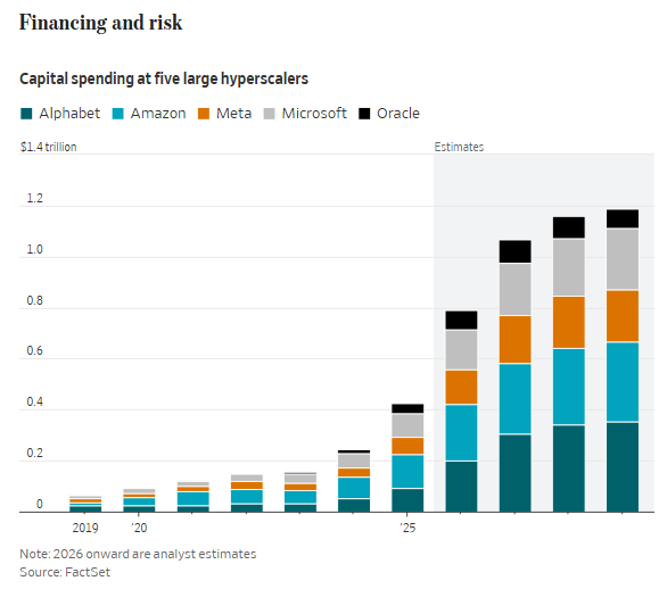
Five major hyperscalers—Alphabet, Amazon, Meta, Microsoft and Oracle—are projected to spend approximately $4.2 trillion on capital projects from 2026 through 2029.
An increasing portion of this AI infrastructure spending is being financed through debt rather than company cash flows.
Technology companies may use off-balance-sheet entities to borrow from banks and private-credit firms, reducing transparency around their total liabilities.
Limited public reporting makes it difficult to assess lenders’ exposure and the broader financial-system risks associated with the AI buildout.
If AI-generated revenue fails to cover data-center debt payments, defaults and falling asset values could spread losses across banks, private-credit funds and other investors.